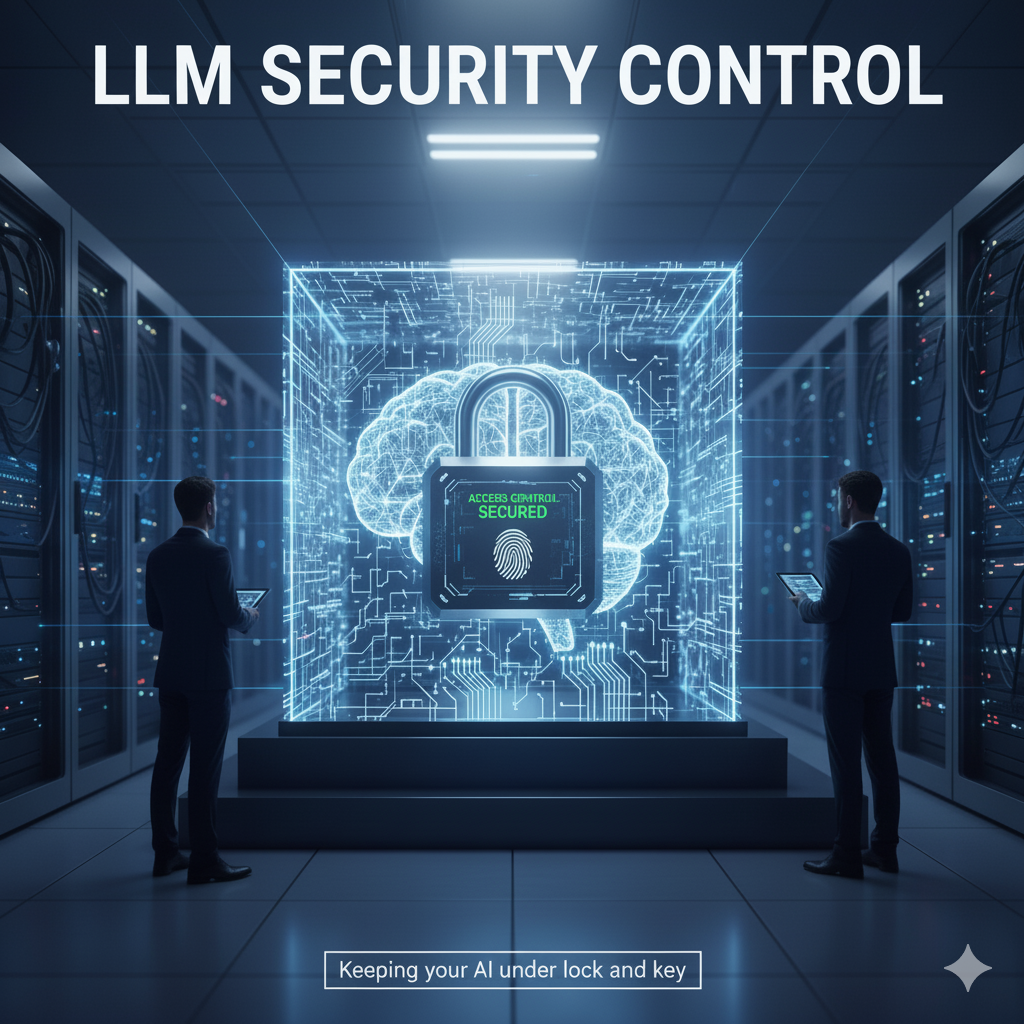
🧠 LLMs Under Your Own Control: How Companies Can Use AI Without Risking Data Leaks
Or: How to join the AI hype without accidentally giving away your company secrets
🚀 Introduction: LLMs Are Hot – But Control Matters
Large Language Models are being sold as the Swiss Army knife of modern IT. They write text, summarize documents, answer customer queries, help with coding, and apparently make reasonably intelligent suggestions in meetings. It sounds like the future, and most companies would love to jump on board.
Then reality hits. The best models live with OpenAI, Google, and friends—and you’d have to send your (often sensitive) data on a round trip through the internet to servers where magic happens. For many companies, this is a non-starter. Compliance, data protection, trade secrets—you know the drill.
But before you throw in the towel, let’s talk about what actually works.
💡 Why Companies Are Drawn to LLMs (Despite the Risks)
The promise is intoxicating. Imagine automating email responses, ticket sorting, and document summarization—everything that used to eat up hours suddenly happens automatically. Internal reports, knowledge bases, meeting notes? An LLM can extract relevant information from massive text volumes faster than any human team. Developers get code explanations on demand, lawyers find precedents more quickly, and sales teams get automatically generated proposals.
In theory, LLMs save time, money, and sanity. In practice, they only do this if you can deploy them securely—and that’s where most companies stumble.
🔐 The Problem: Sensitive Data Doesn’t Belong in Foreign Hands
Let’s be honest about what’s at stake here. Healthcare organizations deal with patient records, diagnoses, and treatment plans—all highly sensitive. Pharmaceutical companies sit on patents, molecular data, and clinical trial results that represent billions in intellectual property. Legal departments handle confidential client information and litigation strategies that could sink cases if exposed. Banks and insurance companies manage customer data, scoring models, and credit decisions under strict GDPR requirements. Government agencies? Their data is definitively not ChatGPT-friendly.
The uncomfortable truth is that most of these organizations are already using LLMs in some capacity, whether they’ve officially approved it or not. Shadow IT is alive and well in the age of AI.
☠️ What Actually Goes Wrong When You “Just Quickly” Feed ChatGPT
Here’s where the optimistic vendor pitches meet cold reality. Data leaks don’t just happen through malicious attacks—they happen through careless prompts and unexpected model responses. Prompt injection lets users manipulate inputs so models reveal things they shouldn’t. Your carefully fine-tuned model? It can be reverse-engineered or stolen. Data poisoning means someone injects malicious information into your index, corrupting everything downstream.
Then there’s the hallucination problem, which isn’t just embarrassing—it causes real legal and financial damage when models confidently invent facts. “Anonymous” data gets re-identified through clever combinations of publicly available information. GDPR compliance? Many cloud solutions are legal minefields waiting to explode. Intellectual property leaks happen in slow motion: strategy documents, source code, research findings—once uploaded, they’re essentially public, even if technically private.
The pattern is clear: companies that don’t pay attention end up with data protection scandals faster than their models can say “Hello World.”
🛠️ Solution Approaches: What Actually Works (And What Doesn’t)
On-Premise: Your Own Data Center Castle
Running everything internally sounds perfect in theory. All data stays in-house, you have maximum control over networking, hardware, and updates. But let’s talk about what they don’t mention in the vendor brochures. It’s expensive—genuinely, painfully expensive. The maintenance burden is substantial, and scaling isn’t trivial when you need to provision physical hardware months in advance.
And here’s the kicker: just because the model runs “in your basement” doesn’t mean it’s secure. You still need governance, access controls, monitoring, and incident response. The threat vectors change but don’t disappear. Internal employees remain your biggest security risk, whether malicious or merely careless.
VPC & Isolated Cloud Instances
This is the middle ground everyone talks about—your model runs in a cordoned-off cloud environment. More flexible than on-premise, theoretically more secure than public cloud. The devil is in the implementation details. Network segmentation and access policies aren’t optional extras; they’re fundamental requirements that most organizations implement poorly. Your “isolated” environment is only as good as your weakest configuration setting.
The real challenge? Maintaining that isolation over time as teams request exceptions, integrations multiply, and the pressure to “just make it work” overcomes security protocols. Three months after deployment, your pristine security model looks like Swiss cheese.
Hybrid: Edge Plus Cloud
This sounds elegant: process sensitive data locally, send only non-critical parts to the cloud. Use data masking, filters, and pseudonymization before the cloud hop. Perfect for companies with legacy IT and cloud ambitions.
But what counts as “non-critical” data? That line keeps moving. Context that seems harmless in isolation becomes sensitive when combined with other information. You’re essentially playing a continuous classification game, and the penalty for getting it wrong is a breach. The complexity of managing dual environments—each with different security models, performance characteristics, and failure modes—often exceeds what mid-sized IT teams can reasonably handle.
RAG (Retrieval-Augmented Generation)
Here’s where things get interesting. Instead of shoving data directly into the model, you reference it through a vector database. The LLM only accesses relevant snippets. This sounds clever until you realize the index itself becomes a new attack surface. What’s in that vector database? How is it secured? Who can query it? How do you prevent sensitive information from leaking through carefully crafted queries?
New approaches like ControlNet function as firewalls against dangerous queries, which is progress. But you’re adding layers of complexity to solve problems created by the previous layer. At some point, you need to ask whether the architectural complexity matches the actual business value.
Privacy-First Technologies
Differential privacy adds noise instead of cleartext—great in theory, less useful when the noise destroys the signal you actually need. Secure Multi-Party Computation (SMPC) and homomorphic encryption let models compute on encrypted data, which sounds magical until you see the performance penalties and implementation complexity. Trusted Execution Environments like Intel SGX provide secure hardware zones, but they’re not immune to attacks and add cost. Synthetic data offers artificial but plausible alternatives to real data, perfect for development and testing, but less useful for production systems that need actual insights.
These technologies are valuable for specific use cases—research, prototyping, certain GDPR-compliant applications. They’re not silver bullets. Each comes with trade-offs in performance, complexity, and actual security gains.
🛡️ Security & Governance: The Unsexy Essentials
You need prompt validation and output filtering, but implementing them effectively requires understanding both your domain and potential attack vectors. Role-based access control sounds simple until you map it to your actual organizational structure with its exceptions, temporary permissions, and special cases. Audit logs and anomaly detection generate massive volumes of data that someone needs to actually review and act upon. Versioning, red teams, and penetration testing for prompts and models require specialized skills that most companies don’t have in-house.
And then there’s the kill switch question: when do you shut down a model that’s producing problematic outputs? Too sensitive, and you’re constantly interrupting legitimate use. Too lenient, and you miss the actual problems. Finding that balance requires judgment that most automated systems don’t have.
💸 Costs & Challenges: The Reality Check
Secure AI operations aren’t cheap, and anyone telling you otherwise is selling something. Hardware costs for GPUs and TPUs add up quickly. Power and cooling for those systems aren’t negligible—you’re essentially running a small data center. Model licenses, fine-tuning, and updates create ongoing expenses. Orchestration, pipelines, and CI/CD for AI systems require specialized tooling. Security audits, monitoring, penetration testing, and compliance don’t happen once—they’re continuous investments.
Then there’s personnel: AI architects, data privacy experts, and DevOps engineers with ML experience command premium salaries. Scaling brings peak costs that can shock finance teams used to predictable infrastructure spending. And here’s the painful truth: time-to-market suffers. ChatGPT goes live quickly. Internal deployments require planning, testing, security reviews, and gradual rollouts.
The question isn’t whether secure AI costs more—it obviously does. The question is whether the business value justifies that cost, and for many use cases, the honest answer is “not yet.”
🧭 Roadmap: Reality-Based Implementation
Start with a pilot project using genuinely non-critical data. Create a threat model before you deploy anything. Begin with a small setup—perhaps RAG plus edge computing—and learn from that experience before scaling. Establish your security framework including governance, logging, and role-based access early. Scale only when your foundations are solid, not when business pressure demands it. Implement regular monitoring and auditing from day one, not as an afterthought.
This takes longer than anyone wants. It’s less exciting than the vendor demos. But it’s what actually works.
🔮 Conclusion: Managing Expectations
LLMs aren’t toys anymore—they’re changing work processes and IT structures in fundamental ways. But using them responsibly requires facing uncomfortable truths. There’s no such thing as 100% security. But you can achieve significantly better security by taking it seriously from the start.
The companies that thrive will treat data protection, governance, and security as design requirements, not compliance checkboxes. They’ll resist the pressure to deploy quickly and instead build foundations that won’t crumble under real-world use. They’ll invest in understanding their actual risks rather than following industry hype.
Don’t bury your head in the sand. But don’t believe the vendors who make it sound easy either. Start small, learn continuously, and build security into everything from the beginning. That’s the only sustainable path forward.
📚 Resources Worth Your Time
For those actually implementing these systems, start with the NIST Framework for Secure LLM Deployment for baseline security principles. Microsoft’s LLM security guidelines offer practical implementation advice despite the vendor bias. Academic papers on ControlNet as a RAG firewall provide theoretical foundations worth understanding. Reviews of privacy technologies including differential privacy, SMPC, and TEE give context for evaluating trade-offs. Stanford HELM’s best practices for secure LLM usage synthesize current thinking despite remaining somewhat idealistic.
The gap between academic best practices and production reality remains substantial. Real-world implementation requires compromises that rarely make it into the published literature.
We will make IT. Securely, eventually, and with realistic expectations.